Mostrando entradas con la etiqueta parmigiano. Mostrar todas las entradas

miércoles, 23 de julio de 2014

Palline di pan d'aglio ripiene


Gli italiani e l'aglio, amore e odio. L'aglio, un elemento antichissimo e estremamente sano, è in Italia tanto odiato quanto amato in alcune regioni. In generale, ma con ampie eccezioni come ad esempio la Toscana ed il Piemonte, al centro-nord non è un elemento particolarmente usato e gradito. In Lombardia è addirittura tollerato, diciamo così, ma sappiate che è un eufemismo. Al sud è invece particolarmente amato ed apprezzato, per insaporire le pietanze e per le sue straordinarie proprietà. È questo un indicatore della variegatezza delle tradizioni e delle culture gastronomiche dello Stivale: quello che è amato in un posto è addirittura poco tollerato in altri, e chi ha viaggiato lungo lo stivale si sarà sicuramente reso conto della estrema varietà culturale presente da nord a sud, indubbio elemento peculiare ed affascinante del nostro Paese. 

Per quanto riguarda l'utilizzo dell'aglio, il sud Italia si può dire che sia più simile alla Spagna che al nord Italia. L'emigrazione dal sud Italia agli Stati Uniti esportò la cultura gastronomica dell'aglio, per cui in America divenne comune associare la cucina italiana all'utilizzo corposo dell'aglio, anche se come abbiamo visto non sempre l'associazione è sempre così automatica.


Aglio

Il pane d'aglio è la versione americanizzata di un antico "piatto povero" della tradizione contadina, la bruschetta. La bruschetta veniva preparata già in epoca romana, ed era costituita da pane vecchio indurito strofinato con aglio ed olio d'oliva particolarmente forte. Nonostante oggi sia una delizia da mangiare con i migliori oli gourmet nei ristoranti, originariamente si strofinava con aglio ed olio per riuscire a conservarlo e consumarlo per più tempo. Di riflesso, anche i ristoranti europei servono il pane d'aglio all'americana. La differenza principale tra il pane d'aglio, o garlic bread italoamericano, e la bruschetta è proprio nella differenza dell'ingrediente dominante: nel garlic bread prevale l'aglio, nella bruschetta prevale invece l'olio d'oliva. Si hanno notizie del Garlic Bread italoamericano addirittura dall'indomani della Seconda Guerra Mondiale.

Ricetta: 

Abbiamo voluto fare nostro il concetto di pane all'aglio, prendendo un elemento da qui e un altro da là, proponendovi qualcosa di diverso, usando la massa della pizza al posto del tipico pane e, per condirlo, ci siamo ispirati a una salsa basata sull'immensa varietà di salse canarie, note come "mojos", di cui vi parleremo estesamente in uno dei prossimi post.

Per fare questa ricetta potrete utilizzare la vostra massa di pizza preferita, quella che più di tutte vi piace, qualunque tipo andrà più che bene per il tipo di piatto che vi proponiamo. Noi di solito usiamo una massa sottile di cui vi abbiamo già parlato in un post anteriore (se vuoi rileggere l'articolo sulla massa della pizza, clicca qui!), per via della sua semplicità e rapidità.

È una ricetta perfetta da prepararsi come antipasto, ideale mangiarla ancora calda, ma anche fredda vanno alla grande! Possiamo preparare in anticipo la massa ed i panetti quando sappiamo che avremo ospiti in casa, dato che il resto della preparazione è piuttosto rapido. Il successo  è garantito!


Ingredienti:
  • 1 Massa per pizza (leggi qui la ricetta)
  • 3 denti d'aglio (al gusto)
  • 30 g. di prezzemolo circa
  • 80 -100 ml di olio d'oliva (meglio se è extravergine)
  • Parmigiano Reggiano (al gusto, ma meglio almeno più di 25-30 grammi)
  • Mozzarella filante 
  • Sale e pepe nero
Preparazione:

1- Facciamo piccole palline uniformi con la massa della pizza, che riempiremo con la mozzarella filante. Mettiamo i panetti sferici in una teglia da forno, ben separati l'uno dall'altro, dato che cresceranno un po'. Li cuoceremo in un forno preriscaldato a 180ºC per circa 15 minuti, o finchè non vedremo che cominceranno a dorarsi leggermente.


Palline pronte per il forno

2- Mentre cuociamo le nostre palline, prepariamo la nostra salsa (o uno "pseudo mojo canario", hahaha!), molto rapida e facile. Per fare ciò, avremo bisogno di un tritatutto, di un Bimby...insomma quello che volete, e forse questa è la principale differenza tra la nostra salsa e il mojo canario (che viene fatto a mano e inoltre non ha formaggio). Mettiamo il tutto nel tritatutto e otteniamo la nostra salsa.


palline pronte ad essere azzannate

3- Quando i nostri panetti sferici saranno pronti, li togliamo dal forno e immediatamente (senza lasciare che si raffreddino!) li mettiamo in una ciotola assieme alla nostra salsa, rigiriamo per bene il tutto affinchè i panetti si bagnino per bene con la salsa e di impregnino di sapore. Se possiamo possiamo grattugiare al di sopra ancora un altro po' di parmigiano e...affrettatevi a mangiarne il più possibile, spariranno subito!


gnam gnam!


Buon appetito!

AnGie

jueves, 5 de junio de 2014

Il pesto alla Trapanese


Il pesto è forse una delle salse più conosciute al mondo. Di certo, quando pensate al pesto, vi verrà in mente il pesto verde, il pesto alla Genovese, basato su basilico e pinoli, ma oggi vi vogliamo parlare di una versione diversa di questa buonissima salsa così versatile, stiamo parlando del "pesto alla trapanese", originario di Trapani, nella splendida Sicilia.

Il pesto alla trapanese si dice che nacque quando le navi genovesi, al ritorno dall'Oriente, attraccavano nel porto di Trapani. In questo modo arrivò l'idea del pesto alla genovese alle terre siciliane, i cui abitanti decisero di cambiarne gli ingredienti con le eccellenze gastronomiche locali, tra cui i deliziosi pomodori e le mandorle.

Il pesto tradizionalmente si fa in un mortaio, ed è per questa maniera di produrlo, pestandolo, che prende per l'appunto il suo nome. In generale, tutti i tipi di pesto hanno almeno un ingrediente in comune: il basilico!
Nell'antichità, per dare un tocco di sapore ai cibi si usavano le spezie, che provenivano dall'Oriente, portate in Europa attraverso Venezia, la Porta sull'Oriente. Ma queste spezie erano a disposizione solo dei più ricchi, gli altri dovevano accontentarsi con ciò che dava loro la terra, il che si scoprì che non era affatto male! Si iniziarono dunque a fare le prime salse per condire i piatti con le erbe medicinali o aromatiche Si dice inoltre che il pesto fu una delle prime salse mai inventate ad essere basata sull'olio.  Ovviamente, la ricetta può variare a seconda dei gusti dei commensali, potete aumentare o diminuire le quantità degli ingredienti a vostro piacimento, ora non ci resta solo che iniziare a provare per sapere come la preferiamo!


Oggi vi porto la versione con pomodorini secchi di questa buonissima e facilissima ricetta!


Ingredienti:
  • 80 g. di mandorle
  • 130 g. di pomodorini secchi
  • 100 g. di Parmigiano Reggiano
  • 10 o 15 foglie di basilico
  • 1/2 cucchiaino di sale marino
  • 2 denti d'aglio
  • Olio d'oliva extravergine

Preparazione:

1- Mettete i pomodorini essiccati per una decina di minuti in acqua tiepida per idratarli un po'.


2- Introduciamo tutti gli ingredienti in un tritatutto, aggiungiamo un bel po' di olio e trituriamo il tutto. La quantità di olio dipende dalla consistenza che vogliamo ottenere, pertanto tritureremo poco a poco e versando olio un po' per volta...ed ecco fatto! Pronto!


Possiamo conservarlo in frigor per un bel po' di giorni, per giunta se lo copriamo con un filo d'olio ci durerà molto di più! Un'altra idea per conservarlo è di congelarlo e tenerlo quindi a disposizione quando ne avremo bisogno. Di solito io lo metto negli stampini per i cubetti di ghiaccio, metto il pesto nei buchetti e così ce l'ho sempre pronto per condire la mia pastasciutta, o quel che mi pare! Ho dei cubetti di tutti i colori ehehe...qualche volta qualcuno, cercando dei cubetti di ghiaccio per rinfrescare il suo bicchiere ha poi scoperto che la sua bevanda aveva "un certo strano sapore"....hahaha! Ma questa è un'altra storia! ;)


Il pesto alla trapanese è una salsa molto versatile, dato che puoi usarla in una infinità di preparazioni, e elaborarla con diverse consistenze, come tu la preferisci, come potete vedere dalle foto qui sopra. Potreste per esempio lasciarlo un po' più secco per le vostre bruschette, potete usarlo come ripieno, per pesce, per le carni, per la pasta...Secondo me poi è perfetta con le orecchiette, con gli spaghetti al nero di seppia e anche con la pasta con le sarde, una squisitezza!


Questo tipo di pesto si fa di solito con i pomodori freschi, che gli danno una consistenza diversa e inoltre non hanno bisogno di così tanto olio, ed è buonissimo anche così. Poi abbiamo anche il pesto alla siciliana, che si fa con la ricotta (gnam gnam!), e innumerevoli altre salse, di cui vi racconteremo in un'altra occasione.

Che aspettate quindi? Provatene tutte le varianti! Come diceva mio papà..."In qualche luogo nel Mondo c'è una stanza gigantesca piena di salse, una per ogni giorno dell'anno"!...beh...dovremmo ascoltarlo! Di varietà ce n'è eccome!

Un salutone e...metteteci salsa sulle vostre vite! ;)

 AnGie

sábado, 24 de mayo de 2014

Historia del Grana Padano

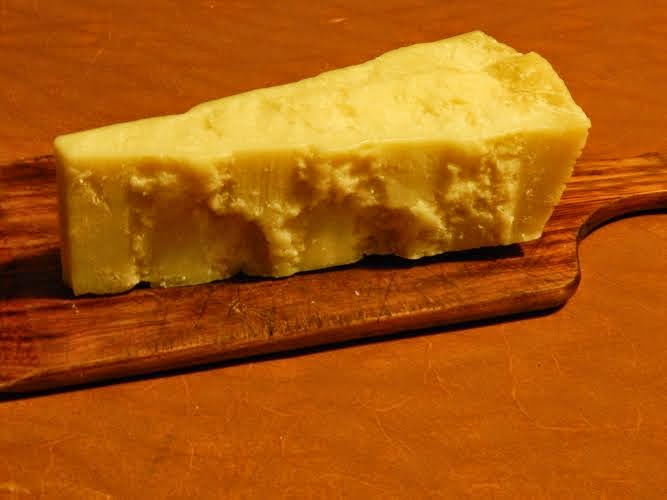
Grana Padano
Cuando se piensa en quesos italianos de pasta dura, se piensa siempre en el que para los italianos es el rey de los quesos: el Parmesano Reggiano ( Parmigiano Reggiano). Sin embargo, también existen otras variedades deliciosas de quesos con dicho tipo de pasta, como por ejemplo, el queso que hoy nos ocupa, el Grana Padano.

El Grana Padano es un queso de leche de vaca que se diferencia ligeramente del Parmesano debido a las técnicas de producción. Por ejemplo, el hecho de que la leche para el Parmesano se deje en los recipientes unas 15 horas, mientras que la leche para elaborar el Grana Padano se trabaja más inmediata, lo que hace que éste último contenga menos grasas que el Parmesano. El Parmesano se elabora alimentando a las vacas con forraje seco, mientras que el Grana permite la alimentación de las vacas con cereales almacenados en silos, lo que da un sabor al Grana algo menos rico en tonos vegetales respecto al Parmesano. Además de media, el Parmesano necesita envejecer más tiempo que el grana Padano

La diferencia en la consistencia viene dada del hecho que el grana tiene una pasta algo más compacta y densa, mientras que el Parmesano se presenta algo más seco debido al mayor tiempo de curación.


Parmesano en curación

Se trata de un producto protegido bajo el marco DOP ( denominación de origen protegido) y realizado sobretodo en la zona de Lombardía, aunque también se fabrica en otras regiones como son Emilia- Romagna, Piemonte, Veneto o el Trentino- Alto Adige. La historia del Grana Padano es muy antigua, y como sucede con todo, se cuentan diversas versiones.

Grana Padano

Después del año mil, hubo un gran renacimiento monástico en toda Europa, y nuevos monasterios y abadías nacieron en todo el viejo continente. Dichos monasterios vivían básicamente del cultivo de las tierras, y los monjes habían elaborado técnicas avanzadísimas para controlar las aguas para poder bonificar y conseguir que fueran cultivables territorios anegados de agua y pantanosos como eran los de la llanura Padana. En todo el norte del país, los monjes pacientemente consiguieron, con la técnica conocida como "marcite",hacer cultivable vastas zonas, lo conlleva a hacer abundante la cantidad de trigo. Esto permite la expansión del ganado, lo que repercute en tener excesos de leche. Se decide por lo tanto crear un queso de larga conservación con todo ese excedente de leche del que disponían.

Según algunos, el primer queso de tipo grana producido fue el de Lodi ( Lodigiano), conocido como Granone. El Lodigiano, era un queso muy particular o especial, que presentaba un sabor picante y contaba con un ligero veteado azul. También lo hacía especial su envejecimiento. Desgraciadamente, la producción de este antiquísimo queso, cesó en los años setenta debido a la industrialización de las producciones, pero se reavivó un proyecto de recuperación de la producción de dicho queso, de nuevo en los primeros años del 2000. 


Granone o Lodigiano


El queso producido hoy en día y vendido como Granone es en todo caso diferente del original, y esto hace difícil los estudios y comparaciones. Cierto es que también el actual Granone es delicioso y tiene un sabor más amargo pero también más profundo que el clásico Grana Padano, por lo que os aconsejamos que merece la pena probarlo.


Torre de Ciribiciaccola
El Grana Padano propiamente dicho, en cambio, se dice que nació en Milán, en la estupenda abbazia gotica de Chiaravalle, en los campos a pocos kilómetros del centro de la ciudad. A la sombra de la "Ciribiciaccola" ( emblemática torre del campanario símbolo del antiguo pueblo de Chiaravalle), los monjes decidieron crear con la abundante cantidad de leche, un queso de pasta dura y largo envejecimiento, cocinado en las calderas de la abadía, las cuales serían las primeras queserías. Tenemos una fecha de nacimiento, se trata del remoto año 1135, por lo que nos encontramos hablando de uno de los más antiguos quesos de Europa que aún hoy en día se produce. Los monjes llamaban a este queso Caseus Vetus, un nombre impronunciable para los pobres campesinos de la época. 

Debido a la consistencia compacta y granulosa, este queso viene rebautizado queso de Grana. Más allá del mencionado queso Grana de Lodi o Lodigiano, el Milanés o Grana Padano, también tuvo mucho éxito el queso Grana de la ciudad de Parma o Parmigiano (Parmesano). De esta excelencia extraordinaria de la cocina italiana hablaremos en otra ocasión, en este momento nos basta solamente decir como en el curso del siglo XII, la técnica del Grana Padano alcanza la zona de Emilia Romagna, y allí fue perfeccionada para consentir el desarrollo del rey de los quesos italianos. No obstante la antigüedad y la nobleza que otorga el ser padre del Parmesano, el grana Padano quedó como una delicia local, bastante ignorada en el panorama gastronómico europeo por varios siglos. 

Fue en la segunda postguerra, en el año 1951, que a través de una reunión en Lombardía, cerca del Lago Mayor, los operarios de las queserías llegaron a un acuerdo sobre las diferencias existentes entre el Parmegiano Reggiano y el Grana Padano, por aquel entonces llamado "Grana Lodigiano". Las primeras normativas nacionales al respecto vienen adoptadas en el 1955, y permiten reconocer también de manera internacional la marca, y el Grana Padano obtiene en 1996 la distinción DOP por parte de la Unión Europea.

La pasta más blanda y menos granulosa del grana Padano, lo diferencian de manera inequivoca de su vecino el Parmesano, y lo convierten en un queso ideal para el consumo también fuera de las cocinas, servido a menudo como aperitivo junto, por ejemplo a un buen vino prosseco o un Riesling.

Es un queso que suele usarse también para obtener escamas sutiles de queso, las llamadas raspaduras. Es un producto de excelencia extraordinario y con un sabor único. La producción de un kilo de Grana Padano necesita 15 litros de leche!, y cada confección de este queso tiene entre 24 y 40 kg, así que hagamos cuentas!. El Grana Padano debe envejecer al menos 9 meses, mientras que el Grana más selecto puede llegar a superar los 20 meses de curación.

Dicho esto, no nos queda más que ir a la búsqueda de un buen Grana Padano DOP y elegir la manera de saborearlo, quizás rallado sobre nuestra pasta, en cuñas, dados, o en su forma tradicional, la raspadura!.


Cortando raspaduras de una pieza de grana Padano

The history of Grana Padano cheese

Marking the Grana Padano
When you think about Italian hard cheeses, you probably will think about what Italian calls the King of Cheeses, the Parmigiano Reggiano. But beside this kind of cheese exists also another cheese: the Grana Padano.

It a gastronomical product protected by the quality label DOP (Denominazione di Origine Protetta) and it is very typical of northern Italian regions like Lombardy but also Emilia-Romagna, Piedmont, Veneto, Trentino - Alto Adige. The differences between the Grana and the Parmigiano are mainly that the first is usually lightier than the latter, that has more fats.
The Parmigiano Reggiano also have a longer period of ripening.


Parmigiano Reggiano ripening

Furthermore, the Grana appears to be more compact and dense, while the Parmigiano, because of the longer ripening period, is dryer and looks somewhat more flaky. Its history is quite ancient and there are lots of different versions of the origins of this delicious cheese.
Let's start! After the Year 1000, which everyone feared would be the the last one, there was a huge monastical renaissance all over Europe. Those monasteries lived of farming and developed a superior knowledge in the cultivation of lands. They were also capable of reclaim the swamp lands in the Pianura Padana, the alluvional plain in northern Italy. In every corner of the northern part of the country so moks patiently worked decade after decade to make of this plain a rich agricultural land. And, as everyone can see nowadays, they succeed! With the innovative technique of the marcite, they succeed in controlling the excess of water in the plain, allowing the farmers to obtain a surplus of corn to feed the cows they breeded. This lead to an excess of milk, and this posed a problem: how can they conserve it properly? They decided to create a cheese to conserve it easily.

The Grana Padano
 
According to some, the first Grana cheese would have been the Lodigiano, also said the Granone. The Lodigiano, that takes its name from the medieval city of Lodi, some 30 km south east of Milan, was a peculiar cheese, with a spicy flavour and light blue veins running through it. A sort of tear used to drop from it when it was cut. Unluckily, the production of this ancient cheese stopped in the 1970s, and only after the 2000s the production was restarted. This new Granone, even if it may be different from the ancient one (we cannot compare them) is anyway very, very good!

The Granone cheese, also called Lodigiano

The "Ciribiciaccola" belfry, symbol of Chiaravalle
As for the Grana Padano, we know the full history pretty well and in details. It was born in Milan, in the (gorgeous) gothic abbey of Chiaravalle, just few kilometers away from the bustling city center. In the shadows of the "Ciribiciaccola", the nickname that the inhabitants of Chiaravalle uses to describe the tall belfry, the monks decided to use the excess of milk in a long ripening hard cheese, cooked in the boiler of the abbey. We have also a year of birth, the 1135, that makes of the Grana Padano one of the oldest cheese still in production. Monks called it Caseus Vetus, in latin, a language that many farmers did not know. They used instead the word Grana for it, because of its dense yet granulous texture. Beside the Grana of Lodi, that we've already mentioned previously, and the Milanese, or Grana Padano, also another Grana had a great success: the Grana cheese from the city of Parma, or Parmigiano. We'll talk of this extraordinary excellence of italian gastronomy in another occasion, in this post we'll just add that in the XII century the Grana cheese reached the Emilia Romagna region and there the technique was developed further, with the creation of the Parmigiano Reggiano. But unlikely the most famous son, the Grana Padano remained a local cheese until recent years. It was only after the II World War, in 1951, that in a meeting in the city of Stresa, on the Lago Maggiore, cheese expert from all Europe established the differences and the peculiarity that divided the Grana Padano and the Parmigiano Reggiano, or the Grana Lodigiano, as it was called in that occasion. The first normatives were established in 1955, and they led the international recognozability of the Grana Padano cheese. In 1996, the Grana also obtained the DOP label by the EU.
The texture of Grana is softer and less granulous that the Parmigiano, and makes it ideal as an appetizer or antipasto. If you want it as an aperitivo, eat it with bubbles! We would suggest you to drink a Prosecco sparkling wine with the Grana Padano. Another way of eating it is the so called "raspadura", very typical of Lodi, but also in Pavia or Cremona. Just scrape off the upper part of your Grana with a particular knife, and you'll obtain a thin layer of Grana Padano, so delicate and tasty. This would be impossible to obtain with a Parmigiano Reggiano.

It is impressive to think that you need 15 liters of milk to obtain just a kilogram of Grana Padano cheese, and every wheel of Grana weights from 24 to 40 kgs!
The Grana Padano must be left ripening from 9 to 20 months.
Well, that's it! Next step is to go out finding your wheel of Grana Padano DOP (always choose the original, do not trust Parmesan or so, they're just low quality tacky imitations!)
Eat it as you want, grated on your spaghetti (we always suggest the pasta from Gragnano), in little cubes or in the traditional raspadura way!

The raspadura from Grana Padano


Enjoy your life, enjoy it with cheeses!

Tom

miércoles, 23 de abril de 2014

The History of Pasta

It's strange to think that once upon a time there were no pasta around us. It's just weird to think not to have spaghetti in our kitchens, that also something so universal has a story, has a birth. But, like tomatoes or potatoes, there has been an era before pasta! Pasta is a simple and genial creation that can be summed up like this: "different shape creates different taste". Is infact a nonsense to consider the pasta without his mate, the tomato sauce, or, in italian, the "sugo". The sauces can be more or less liquid, or dense, with meat or fish, they can have different textures and so on. And this is the reason for the thousand different types and shapes of pasta, to better keep the sauce and its flavour. Almost every single town has his own type, at least in the central and southern Italy. The marriage between the sauce and pasta has been developed throughout centuries, often using different local gastronomical excellences. According to a study, exists at least 563 different kinds of pasta.


The astonishing variety of Tagliatelle

One could argue that from the thousands kinds and different shapes of local pasta and its related "pasta chauvinism" begun the unique italian passion for the creativity and the design. And, by the way, how was created pasta?
In XIX century pasta became a luxury everyone could afford

According the legend, Marco Polo would have brought spaghetti from his legendary travel to China. But there are many doubts about this romantic narration. There are traces of pasta in Western World even before Marco Polo.
For example, Cicero used to eat a dish called Làgana. The Laganum was a sort of flat pasta very similar (also in the name) to our lasagna. It is interesting to notice that even two thousand years after Cicero, in some parts of Italy lasagna are still called lagana! Someone thinks that the whole Marco Polo legend was created by the Macaroni Journal (a italo-american review) to promote a dish yet not so well known in America.

But moving from legends to history, the actual origin of pasta is far from being
perfectly known. For example we know that the Greeks used to ate pasta, and so did the Etruscans. It is thought that pasta is a dish that grew together with the civilizations of Man along his expansion throughout Eurasia. When Man started to cultivate cereals and in the Neolithic started to create tools to mill cereals and then add water.
In the Middle Ages Italy, pasta was made like this

But beside this historical ride, we can say that the first traces of the pasta intended as we do in modern times is to be found around XIV century. During Middle Ages infact the pasta starts being boiled, and no longer put in an oven. There is a written document from that period, the "Liber de Coquina", that describes how to do the tagliatelle, from a neapolitan writer. In Italy we use to say "pastasciutta", rather than pasta, and that's because the dried pasta that we know today was created to last longer, probably by arabs that used it to eat when crossing the Sahara desert. In Sicily, that was then invaded by arabs, the water was abundant, and pasta started to be boiled rather than baked. The success was so great that many small shops started the commerce of this product. Other pasta shop then opened in the great portual cities, like Neaples and Genoa, then in Apulia and Tuscany and from there to the rest of Italy and the World.


Once that America was discovered and the tomato was brought here in Europe, pasta was ready to the final and most glorious step. In the previous centiries infact pasta was served with meat, meat sauces and cheeses (yes, the cheese always was there, we can immagine the Romans eating their pasta with Parmigianvs Reggianvs he he he!).

Around year 1500 were created in the small city of Gragnano, near Naples, the first artesanal "pastifici", or pasta ateliers, that back then were family-run. The Gragnano pasta, now legendary to gourmets, foodie, chefs and simple pasta lovers worldwide, is unique because of the particular climatological conditions of the small city, that's settled just above a valley, on the Monti Lattari mountains. In the baroque era, a crisis in the textile sector converted the vast majority of Gragnanese people to work in the "pastifici". Many watermills were then built to work the pasta in the valley below, more than thirty, that you can see still now in the so-called "Valle dei Mulini", or the "Mills valley".


Pasta left to dry in Via Roma, Gragnano's main street


After the Industrial Revolution, in the Eighteenth Century, were introduced in
today things have changed, but the taste is the same!
Gragnano modern and industrial machineries that lead to a bigger production and a smaller price, now finally everyone could afford some pasta from Gragnano! With the Unification of Italy in 1861, Gragnano started to export his delicious pasta also in the big cities of Central and Northern Italy, like Florence, Rome, Turin and Milan. To understand the importance of this small city, we can tell you that in year 1885 the railway that linked Gragnano and its pasta production with Naples (and so with the rest of Italy) was inaugurated by the King of Italy himself, Umberto I of Savoy and his wife, the famous Queen Margherita of Savoy (yes, the pizza Margherita was named after her).


Pasta di Gragnano is our favourite!

After a decline in the XX century, today Gragnano has rebirth as the "city of Pasta" par excellence. Today the city is the first pasta producer and pasta exporter in Italy. We can conclude or super tasty ride with the words of a myth of the neapolitan cultural world, a genial and ironical figure of the Italian Theater and Cinema: Antonio de Curtis, better known as Totò: "Se non è di Gragnano, desisti!", that can be translated as "If the pasta is not from Gragnano, give up!"


Greetings al dente!

Tom

martes, 15 de abril de 2014

Pane agli aromi Mediterranei


Il 2014 è l'anno internazionale della dieta mediterranea, così sana e raccomandabile. Per festeggiarlo oggi vi portiamo un pane molto...mediterraneo, per via del suo sapore di pomodoro, formaggio e cipolla, con un tocco del nostro oro più prezioso, l'olio d'oliva. Può esserci al Mondo qualcosa di più mediterraneo del pane? O dell'olio d'oliva?


Per fare questo tipo di pane mi sono ispirato a uno dei grandi pani classici italiani, il filone, a cui ho poi aggiunto pomodorini essiccati al sole, formaggio Grana Padano e cipolla.

E' un pane per tutti i giorni, che è delizioso così com'è è non ha bisogno di alcun accompagnamento, anzi, crea dipendenza! Per giunta, se ce ne è avanzato un po' dal giorno anteriore, possiamo tagliarlo a metà e riscaldarlo o tostarlo, accompagnandolo con un filo d'olio d'oliva extravergine...spettacolare! Dato che poi non avrete bisogno della massa madre, è anche adatto a tutti coloro i quali stanno iniziando a fare il pane in casa, dato che è facile e relativamente rapido da fare. Provatelo!

Ingredienti:


Per la massa iniziale: 


  • 15 g. di lievito di birra
  • 250 ml di acqua tiepida
  • 375 g. di farina
Per la massa principale:
  • 300 g. di farina
  • 150 ml. di acqua tiepida
  • 15 g. di lievito di birra
  • 2 cucharillas di zucchero di canna
  • 50 g. di Grana Padano
  • 1 Cipolla grande
  • 15 pomodori secchi
  • 60 g di olio extravergine di oliva
  • 1 cucchiaino di sale
  • farina per lavorare la massa
Preparazione:

1º- Prepariamo la massa iniziale, per fare ciò mettiamo acqua tiepida in una ciotola e poi versiamo dentro il lievito, aggiungiamo la farina e giriamo per bene facendo una sorta di pallina. Copriamo il tutto con carta trasparente o un panno da cucina pulito e lasciamo che riposi per circa 30 minuti.
2º- Peliamo e tagliamo la cipolla secondo il modo che preferiamo, nel mio caso l'ho tagliata alla brunoise, cioè a dadini piccoli. Soffriggiano la cipolla in una padella precedentemente riscaldata e mettiamo da parte il tutto.
la massa finale pronta per l'ultimo riposo
3º- In una ciotola mettiamo acqua, lievito e zucchero, agitiamo finchè il tutto non si sia dissolto. Aggiungiamo l'olio, la farina, il sale, il formaggio gratugiato, la cipolla, e i pomodori tagliati in pezzi non troppo grandi. Aggiungiamo la nostra palla di massa precedentemente realizzata. Ammassiamo il tutto in una superficie cosparsa di farina finchè la massa risultante non sarà perfettamente omogenea.
Se mentre lavoriamo la massa vediamo che è ancora molto appiccicosa, aggiungeremo ancora della farina. Chiaramente questo passaggio lo possiamo fare con un mixer o con un robot da cucina. Quando alla fine la nostra massa sarà perfettamente omogenea, la metteremo in una ciotola e la copriremo con carta trasparente per altri 30 minuti.


Come mi piace stare con le mani nella massa!

4º- Una volta che sono passati i minuti indicati, prepariamo ed infariniamo un panno da cucina. Dividiamo la massa in diversi sfilatini della misura che preferiamo e li disponiamo poi nel panno nel modo che vediamo nella foto, ripiegandolo spazio tra uno sfilatino e l'atro per non lasciare che le masse si attacchino l'una all'altra. Lasciamo riposare i pani altri 30 minuti.


5º- Passato questo tempo, vediamo come i nostri pani saranno cresciuti ancora un po'. Con un coltello molto affilato, facciamo dei taglietti trasversali lungo la superficie dei nostri pani.
6º- Cuciniamo nel forno preriscaldato a 180° C, con calore sotto e sopra durante circa 20-25 minuti. Con queste quantità mi sono venuti fuori circa 7 sfilatini di pane di differente misura.


Godetevi la ricetta e non dimenticatevi di fare dell'ottimo pane casalingo! Se poi volete avere un'altra ricetta su un pane rustico di nostra invenzione, a questo link potrete trovarla!


Salutoni!

AnGie

Mediterranean flavoured bread


2014 is the International Year of the Mediterranean Diet, so good and healthy. To celebrate this fact we bring you a bread really Mediterranean, and I tell you this because of his ingredients: tomato, cheese and onion with that golden touch of the Olive Oil. Can there be a more mediterranean thing than bread? Or olive oil?

For this kind of bread, I found my inspiration in the italian bread called "filone". It's and everyday bread, and it just do not need any addings and makes you addict to it! In the unlikely event of not eating it all right away, in the following days you can open it and warm it or toast it, you'll just need a drizzle of olive oil, and it will be just espectacular! 
This bread do not need the sourdough, and so it's perfect for those who are beginners in the art of bread. It's simple and fast, try it! Here in our blog we absolutely loves breads, and if you want another recipe from ours, here you are!


Ingredients:


For the first dough: 


  • 15 g.of brewer's yeast
  • 250 ml of warm water
  • 375 g. of flour
For the main dough:
  • 300 g. of flour
  • 150 ml.of warm water
  • 15 g. of brewer's yeast
  • 2 spoonful of brown sugar
  •  50 g. of Grana Padano cheese
  • 1 big onion
  • 15 sundried tomatoes
  • 60 g of extra vergin olive oil
  • 1 spoonful of salt
  • more flour to work with the dough
Preparation: 

1º- We prepare the first dough, and to do so, in a bowl we add some warm water and we put in there the yeast. Add the flour and stir ithoroughly until we'll have a ball. Cover it with a plastic wrap or a kitchen towel and let it rest for about 30 minutes.
2º- We peel and cut à là brunoise our onion, that is in little dices. Fry it in a heated pan and put it aside.
The final dough ready for the last rest
3º- In a bowl, put the water and add the yeast and the sugar, stir to dissolve it. Add the oil, the flour, the salt, the shredded cheese, and the minced tomatoes. Add to our first dough, that now is a ball. Knead the dough in a surface covered with flour until it's completely uniform. If the dough is too sticky, just add some more flour. You can do this step with a kitchen robot or a mixer, of course! When it is uniform, we put the dough into a bowl and we cover it with a plastic wrap, and let it rest for other 30 minutes.


With the hands in the dough...what a joy!

4º- When you're done with this step, prepare and put some flour on a kitchen towel. Divide the dough into cylinders of the size you want and put them above the towel, each cylinder separated by a folding on the towel like you see in the picture, so that the breads won't stick to each other. Let it rest for other 30 minutes. 


5º- AftePasado er this time, we can see our breads have grown a little bit. With a well sharped knife, do some cuttings on the surface of the breads.


6º- Bake them in a preheated oven at 180° C with no fan for 20-25 minutes.

Enjoy the recipe and keep eating mediterranean bread!


Saludos

AnGie