Mostrando entradas con la etiqueta cheese. Mostrar todas las entradas

martes, 12 de mayo de 2015

The Canary Islands' Almogrote cheese cream


The almogrote is a delicious cheese cream typical of the Canary Islands, and overall of the island of La Gomera. We'll see later on this post the recipe in detail, what we can anticipate you now is that the main ingredients for this canarian delice are mainly olive oil, garlic, mature cheese and pimentón, a spanish spice similar to paprika, all beaten in a mortar with a pestle.
This unbelievably tasty cheese cream (try it and you believe it!) has a very long history, that begun in the rich gastronomy of the spanish Jews, called the Sephardim (from the identification of Spain with the Biblical western country of Sepharad).


The Spanish Separdi Jews modified an ancient roman sauce called moretum (probably the granpa of the pesto sauce). The moretum (from the greek verb "moreon", to stir) was made mixing olive oil, cheese, garlic, vinegar, wine and aromatic herbs. Here comes the Sephardi touch: they reduced the quantity and the proportion of the ingredients, in order to obtain a delicious cream instead of a a liquid sauce. In the late stage of the Roman empire, the names were frequently modified and corrupted, and this happened to the moretum too, that, misspelled, became "modretum".

The Sephardi cream cheese continued being popular also during the Islamic domination of Spain. During this stage, the name of the dish was modified from modretum to al-modrote.


The Al Modrote was a popular Sephardi recipe until the XVII century: by that time, all jews of Spain were all converted to catholicism or expelled and their goods confiscate.

But, even if the decision of the Catholic Monarchs of getting rid of the jews in Spain was highly unethical, the Sephardi gastronomical tradition continued elsewhere, in the remote lands and islands of the Spanish Empire and also in other countries.

For example, one of Europe's most influential rationalist-pantheist philosopher, the Netherland-born Baruch Spinoza, was a Sephardi jew whose parents were expelled from Portugal.


But let's get back to the cuisine! We said that a large amount of Sephardim found their new house in the remote lands of the Spanish empire, and many of them choosed the flourishing harbours of the Canary Islands, on the Atlantic route to Americas. There they regained the fortunes the loosed in the mainland investing in the Atlantic commerce. During the Sixteenth Century, the Spanish Siglo de Oro, many Sephardim had their own Siglo de Oro in Canary Islands, after hard times in continental Spain. In the Atlantic archipelago, it's very likely that many of the Spanish Jews continued their gastronomical tradition. Here, the almodrote was matched with two gastronomical gems of the Canary Islands: the Queso de la Gomera, one of the very best Spanish cheeses still nowadays, and the incredible taste of the pepper of La Palma. 


In the island of La Gomera, the almodrote became the best version of itself, and its name was changed to almogrote, the ultimate cheesy cream. The almogrote, despite the fact of being less known than it would deserve to be, is still growing in popularity and gastronomical appreciation througout the World. We love this gourmet cream made of the best cheeses, we love the almogrote!
Here goes the recipe!


Recipe:


Ingredients: The quantities of the ingredients are orientatives, since it depends mainly on the kind of cheese you're using and the texture of the cheese cream you're looking for. Try and develop your own golden ratios! ;)

- 320 g. of hard mature cheese
- 200 ml. of olive oil
- 2 sweet peppers from La Palma (you can use also ñora or choricero peppers, or mexican Anchos red peppers)
- 2 garlic cloves
- Salt and pepper to taste (it depends also on the kind of cheese you're using, for many kinds of cheese are already savoury enough)
- Optional: hot pepper (like the mexican jalapeño, use it just if you like it veerrrrry spicy!). 

Pimienta Palmera


Preparación: 

1- Even if traditionally the almogrote was prepared in a mortar, nowadays you can do it in a mixer. First, grate the cheese, possibly a very mature and hard one (and if it's from La Gomera island is even better!).

2- Boil the peppers, so to hydrate them and then extract all the pepper pulp and put it into the stand mixer. Add to the mixer the rest of the ingredients, that are the garlic cloves and the grated cheese. Little by little, while beating, keep adding the olive oil, just as you would do to make a mayonnaise, until you reach the texture you prefer.

3- Very important! This is crucial K? Take a slice of a crunchy fresh bread and spread the almogrote above it and...nom nom! Keep the almogrote in a jar and pop it into the fridge, and if it dries up then add some olive oil to conserve it longer (even if -trust me- it won't last long he he he!)


I personally prefer a creamy texture, but still I want to notice little, irregular bites of hard cheese under my teeth, but that's of course a personal taste!

A fast version of the almogrote can be easily obtained with very good results, without grating the cheese. Put all the ingredients together in the mixer with the half of the olive oil, mix it all and at the end correct the texture by adding little by little more olive oil, the exact amount it depends on the kind of hard cheese we're using.

There are many versions of the recipe, someone uses mature tomatoes too, but to be honest this is not the most typical choice, Someone uses a spoonful of sweet (or spicy) pimentón to enforce the flavour. The pimentón is a good alternative though if you can't find peppers anyway.

It's soo easy and tasty you won't believe it!

Try it and you'll repeat it!


Image and video hosting by TinyPic

sábado, 24 de mayo de 2014

The history of Grana Padano cheese

Marking the Grana Padano
When you think about Italian hard cheeses, you probably will think about what Italian calls the King of Cheeses, the Parmigiano Reggiano. But beside this kind of cheese exists also another cheese: the Grana Padano.

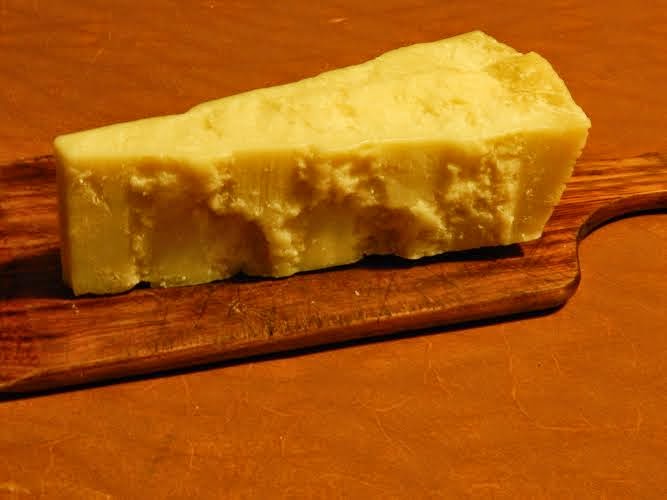
It a gastronomical product protected by the quality label DOP (Denominazione di Origine Protetta) and it is very typical of northern Italian regions like Lombardy but also Emilia-Romagna, Piedmont, Veneto, Trentino - Alto Adige. The differences between the Grana and the Parmigiano are mainly that the first is usually lightier than the latter, that has more fats.
The Parmigiano Reggiano also have a longer period of ripening.


Parmigiano Reggiano ripening

Furthermore, the Grana appears to be more compact and dense, while the Parmigiano, because of the longer ripening period, is dryer and looks somewhat more flaky. Its history is quite ancient and there are lots of different versions of the origins of this delicious cheese.
Let's start! After the Year 1000, which everyone feared would be the the last one, there was a huge monastical renaissance all over Europe. Those monasteries lived of farming and developed a superior knowledge in the cultivation of lands. They were also capable of reclaim the swamp lands in the Pianura Padana, the alluvional plain in northern Italy. In every corner of the northern part of the country so moks patiently worked decade after decade to make of this plain a rich agricultural land. And, as everyone can see nowadays, they succeed! With the innovative technique of the marcite, they succeed in controlling the excess of water in the plain, allowing the farmers to obtain a surplus of corn to feed the cows they breeded. This lead to an excess of milk, and this posed a problem: how can they conserve it properly? They decided to create a cheese to conserve it easily.

The Grana Padano
 
According to some, the first Grana cheese would have been the Lodigiano, also said the Granone. The Lodigiano, that takes its name from the medieval city of Lodi, some 30 km south east of Milan, was a peculiar cheese, with a spicy flavour and light blue veins running through it. A sort of tear used to drop from it when it was cut. Unluckily, the production of this ancient cheese stopped in the 1970s, and only after the 2000s the production was restarted. This new Granone, even if it may be different from the ancient one (we cannot compare them) is anyway very, very good!

The Granone cheese, also called Lodigiano

The "Ciribiciaccola" belfry, symbol of Chiaravalle
As for the Grana Padano, we know the full history pretty well and in details. It was born in Milan, in the (gorgeous) gothic abbey of Chiaravalle, just few kilometers away from the bustling city center. In the shadows of the "Ciribiciaccola", the nickname that the inhabitants of Chiaravalle uses to describe the tall belfry, the monks decided to use the excess of milk in a long ripening hard cheese, cooked in the boiler of the abbey. We have also a year of birth, the 1135, that makes of the Grana Padano one of the oldest cheese still in production. Monks called it Caseus Vetus, in latin, a language that many farmers did not know. They used instead the word Grana for it, because of its dense yet granulous texture. Beside the Grana of Lodi, that we've already mentioned previously, and the Milanese, or Grana Padano, also another Grana had a great success: the Grana cheese from the city of Parma, or Parmigiano. We'll talk of this extraordinary excellence of italian gastronomy in another occasion, in this post we'll just add that in the XII century the Grana cheese reached the Emilia Romagna region and there the technique was developed further, with the creation of the Parmigiano Reggiano. But unlikely the most famous son, the Grana Padano remained a local cheese until recent years. It was only after the II World War, in 1951, that in a meeting in the city of Stresa, on the Lago Maggiore, cheese expert from all Europe established the differences and the peculiarity that divided the Grana Padano and the Parmigiano Reggiano, or the Grana Lodigiano, as it was called in that occasion. The first normatives were established in 1955, and they led the international recognozability of the Grana Padano cheese. In 1996, the Grana also obtained the DOP label by the EU.
The texture of Grana is softer and less granulous that the Parmigiano, and makes it ideal as an appetizer or antipasto. If you want it as an aperitivo, eat it with bubbles! We would suggest you to drink a Prosecco sparkling wine with the Grana Padano. Another way of eating it is the so called "raspadura", very typical of Lodi, but also in Pavia or Cremona. Just scrape off the upper part of your Grana with a particular knife, and you'll obtain a thin layer of Grana Padano, so delicate and tasty. This would be impossible to obtain with a Parmigiano Reggiano.

It is impressive to think that you need 15 liters of milk to obtain just a kilogram of Grana Padano cheese, and every wheel of Grana weights from 24 to 40 kgs!
The Grana Padano must be left ripening from 9 to 20 months.
Well, that's it! Next step is to go out finding your wheel of Grana Padano DOP (always choose the original, do not trust Parmesan or so, they're just low quality tacky imitations!)
Eat it as you want, grated on your spaghetti (we always suggest the pasta from Gragnano), in little cubes or in the traditional raspadura way!

The raspadura from Grana Padano


Enjoy your life, enjoy it with cheeses!

Tom

miércoles, 23 de abril de 2014

The History of Pasta

It's strange to think that once upon a time there were no pasta around us. It's just weird to think not to have spaghetti in our kitchens, that also something so universal has a story, has a birth. But, like tomatoes or potatoes, there has been an era before pasta! Pasta is a simple and genial creation that can be summed up like this: "different shape creates different taste". Is infact a nonsense to consider the pasta without his mate, the tomato sauce, or, in italian, the "sugo". The sauces can be more or less liquid, or dense, with meat or fish, they can have different textures and so on. And this is the reason for the thousand different types and shapes of pasta, to better keep the sauce and its flavour. Almost every single town has his own type, at least in the central and southern Italy. The marriage between the sauce and pasta has been developed throughout centuries, often using different local gastronomical excellences. According to a study, exists at least 563 different kinds of pasta.


The astonishing variety of Tagliatelle

One could argue that from the thousands kinds and different shapes of local pasta and its related "pasta chauvinism" begun the unique italian passion for the creativity and the design. And, by the way, how was created pasta?
In XIX century pasta became a luxury everyone could afford

According the legend, Marco Polo would have brought spaghetti from his legendary travel to China. But there are many doubts about this romantic narration. There are traces of pasta in Western World even before Marco Polo.
For example, Cicero used to eat a dish called Làgana. The Laganum was a sort of flat pasta very similar (also in the name) to our lasagna. It is interesting to notice that even two thousand years after Cicero, in some parts of Italy lasagna are still called lagana! Someone thinks that the whole Marco Polo legend was created by the Macaroni Journal (a italo-american review) to promote a dish yet not so well known in America.

But moving from legends to history, the actual origin of pasta is far from being
perfectly known. For example we know that the Greeks used to ate pasta, and so did the Etruscans. It is thought that pasta is a dish that grew together with the civilizations of Man along his expansion throughout Eurasia. When Man started to cultivate cereals and in the Neolithic started to create tools to mill cereals and then add water.
In the Middle Ages Italy, pasta was made like this

But beside this historical ride, we can say that the first traces of the pasta intended as we do in modern times is to be found around XIV century. During Middle Ages infact the pasta starts being boiled, and no longer put in an oven. There is a written document from that period, the "Liber de Coquina", that describes how to do the tagliatelle, from a neapolitan writer. In Italy we use to say "pastasciutta", rather than pasta, and that's because the dried pasta that we know today was created to last longer, probably by arabs that used it to eat when crossing the Sahara desert. In Sicily, that was then invaded by arabs, the water was abundant, and pasta started to be boiled rather than baked. The success was so great that many small shops started the commerce of this product. Other pasta shop then opened in the great portual cities, like Neaples and Genoa, then in Apulia and Tuscany and from there to the rest of Italy and the World.


Once that America was discovered and the tomato was brought here in Europe, pasta was ready to the final and most glorious step. In the previous centiries infact pasta was served with meat, meat sauces and cheeses (yes, the cheese always was there, we can immagine the Romans eating their pasta with Parmigianvs Reggianvs he he he!).

Around year 1500 were created in the small city of Gragnano, near Naples, the first artesanal "pastifici", or pasta ateliers, that back then were family-run. The Gragnano pasta, now legendary to gourmets, foodie, chefs and simple pasta lovers worldwide, is unique because of the particular climatological conditions of the small city, that's settled just above a valley, on the Monti Lattari mountains. In the baroque era, a crisis in the textile sector converted the vast majority of Gragnanese people to work in the "pastifici". Many watermills were then built to work the pasta in the valley below, more than thirty, that you can see still now in the so-called "Valle dei Mulini", or the "Mills valley".


Pasta left to dry in Via Roma, Gragnano's main street


After the Industrial Revolution, in the Eighteenth Century, were introduced in
today things have changed, but the taste is the same!
Gragnano modern and industrial machineries that lead to a bigger production and a smaller price, now finally everyone could afford some pasta from Gragnano! With the Unification of Italy in 1861, Gragnano started to export his delicious pasta also in the big cities of Central and Northern Italy, like Florence, Rome, Turin and Milan. To understand the importance of this small city, we can tell you that in year 1885 the railway that linked Gragnano and its pasta production with Naples (and so with the rest of Italy) was inaugurated by the King of Italy himself, Umberto I of Savoy and his wife, the famous Queen Margherita of Savoy (yes, the pizza Margherita was named after her).


Pasta di Gragnano is our favourite!

After a decline in the XX century, today Gragnano has rebirth as the "city of Pasta" par excellence. Today the city is the first pasta producer and pasta exporter in Italy. We can conclude or super tasty ride with the words of a myth of the neapolitan cultural world, a genial and ironical figure of the Italian Theater and Cinema: Antonio de Curtis, better known as Totò: "Se non è di Gragnano, desisti!", that can be translated as "If the pasta is not from Gragnano, give up!"


Greetings al dente!

Tom

martes, 15 de abril de 2014

Mediterranean flavoured bread


2014 is the International Year of the Mediterranean Diet, so good and healthy. To celebrate this fact we bring you a bread really Mediterranean, and I tell you this because of his ingredients: tomato, cheese and onion with that golden touch of the Olive Oil. Can there be a more mediterranean thing than bread? Or olive oil?

For this kind of bread, I found my inspiration in the italian bread called "filone". It's and everyday bread, and it just do not need any addings and makes you addict to it! In the unlikely event of not eating it all right away, in the following days you can open it and warm it or toast it, you'll just need a drizzle of olive oil, and it will be just espectacular! 
This bread do not need the sourdough, and so it's perfect for those who are beginners in the art of bread. It's simple and fast, try it! Here in our blog we absolutely loves breads, and if you want another recipe from ours, here you are!


Ingredients:


For the first dough: 


  • 15 g.of brewer's yeast
  • 250 ml of warm water
  • 375 g. of flour
For the main dough:
  • 300 g. of flour
  • 150 ml.of warm water
  • 15 g. of brewer's yeast
  • 2 spoonful of brown sugar
  •  50 g. of Grana Padano cheese
  • 1 big onion
  • 15 sundried tomatoes
  • 60 g of extra vergin olive oil
  • 1 spoonful of salt
  • more flour to work with the dough
Preparation: 

1º- We prepare the first dough, and to do so, in a bowl we add some warm water and we put in there the yeast. Add the flour and stir ithoroughly until we'll have a ball. Cover it with a plastic wrap or a kitchen towel and let it rest for about 30 minutes.
2º- We peel and cut à là brunoise our onion, that is in little dices. Fry it in a heated pan and put it aside.
The final dough ready for the last rest
3º- In a bowl, put the water and add the yeast and the sugar, stir to dissolve it. Add the oil, the flour, the salt, the shredded cheese, and the minced tomatoes. Add to our first dough, that now is a ball. Knead the dough in a surface covered with flour until it's completely uniform. If the dough is too sticky, just add some more flour. You can do this step with a kitchen robot or a mixer, of course! When it is uniform, we put the dough into a bowl and we cover it with a plastic wrap, and let it rest for other 30 minutes.


With the hands in the dough...what a joy!

4º- When you're done with this step, prepare and put some flour on a kitchen towel. Divide the dough into cylinders of the size you want and put them above the towel, each cylinder separated by a folding on the towel like you see in the picture, so that the breads won't stick to each other. Let it rest for other 30 minutes. 


5º- AftePasado er this time, we can see our breads have grown a little bit. With a well sharped knife, do some cuttings on the surface of the breads.


6º- Bake them in a preheated oven at 180° C with no fan for 20-25 minutes.

Enjoy the recipe and keep eating mediterranean bread!


Saludos

AnGie

miércoles, 9 de abril de 2014

The Gorgonzola cheese

When you talk about Gorgonzola, you immediately think about one of the most important cheeses in every italian kitchen. It is frequently confused with other kinds of blue cheeses, like the english Blue Stilton or the french Roquefort. But behind this delicious cheese there is a whole lot of history with capitular h, and also many legends and myths. One would think it would be an alchemical product, rather than a cheese, whose secret has been told generation after generation until recent times, when it finally seems to start getting the international fame it surely deserves. But the way until the complete rediscovery of Gorgonzola has a very long way to go, since you can still find in shops around the World just the soft and sweetend version of it. Trust us, to eat the real thing, the spicy tough Gorgonzola cheese, when authentic and produced like 1000s years ago, is a true legendary culinary experience you won't never forget!

When we start hearing about Gorgonzola cheese first? This is one of the oldest cheese still in commerce now ever, so we gotta go back and back and back. And back again! The first document talking about a cheese having all the main feature of Gorgonzola is from year 881 a.C., when the Archbishop of Milan, Anspertus from Biassono, in his last will described this kind of cheese. But legends put the turning point in the history of Gorgonzola even earlier. According a legend, in the year 879 a.C., the blue cheese would have been invented in the Gorgonzola borough of Milan, explaining the name of this cheese. Another legend wants that the cheese would have been invented in the VIII century a.C., when some sheperds, coming back from the Alps with their sheeps, would have stopped overnight and there, without the instruments to make their typical Lombard creamy cheeses like Crescenza or Quartirolo (we'll talk about these ancient cheeses too, do not worry) would have mixed the curdle of the previous night with the fresh one of the morning. That "error" would have eventually lead to the creation of the Gorgonzola cheese.

The Gorgonzola cheese is know also as the "Grandpa's cheese"

The "Zola" cheese, as is informally known here in Northern Italy, had huge success from the XIX century, when it was discovered in the kitchens of the European high aristocracies by merit of its taste, just so original and unmarchable (if you tried the original Gorgonzola, you'll know what I mean).
It is just so different from other blue cheese, like what Guinness is to other beers.
In the other blue cheeses, the milky part prevail over the aromatic part, instead with the Gorgonzola the strong spicy and  aromatic part dominates the milky part, but without being too much in your face. It is an incredibly culinary controlled risk the Gorgonzola, but when you'll eat it, you'll just go "whoa!" like you've just had a rollercoaster experience. 
There are lots of curiosities too, for example the Gorgonzola was the only italian cheese present in the first class dinner in the menù of the Titanic. Not even the Pecorino nero di Pienza or the 36-months-old Parmigiano Reggiano was there!
Some decades later, we can add that Churchill himself, in the heavy Milan bombings by Royal Air Force, forbid the planes to hit the city of Gorgonzola, so to not damage the production of the cheese he was very fond of.
What makes its taste so different and unique? It is because of the higher number of different types of bacterical cultivations inside the cheese. Other blue cheese have only the pennicillium roqueforti, that gives light blue veins, but the green veins of the Gorgonzola comes from another kind of bactery, the pennicillium glaucum, enriching the flavour.

The gourmet food lovers just adore the original Gorgonzola Piccante!

Even if today you can find in many supermarkets worldwide the sweet version of the Gorgonzola cheese, there is a different version, realized exactly as it was produced 1200 years ago: the Gorgonzola Piccante, or the spicy Gorgonzola. The differences are overall in the consistence of the cheese, the sweet one being creamy and somewhat melted, with fewer blueish veins with a delicate colour. The Gorgonzola Piccante is tough in consistence and taste, and the veins are much more evident. The Zola Dolce needs a ripening of two months maximum, while the Piccante needs a ripening of three months at least. Because of the very traditional way of making it, the Gorgonzola Piccante is very complicate to find it outside of Italy, so if you get the chance to see it, don't hesitate and buy it! You'll be rewarded with a strong and involving taste, ideal to drink with strong red wines like the Piedmont's Barolo (isn't it the king of wines? Drink it with the king of cheeses then!), the Brunello di Montalcino, the Amarone or the Barbaresco.
Try it with some rustic crunchy bread, and you'll understand the full range of the Gorgonzola cheese taste. Both the Gorgonzolas, the Dolce and the Piccante, are a real secret weapon in the kitchen, you can use it to do white sauces (for example our gorgonzola bechamel sauce), or as an ingredient in your pizzas, or even with meat or gourmet hamburgers. In the risottos the Gorgonzola is the ideal match, maybe with some red radicchio salad.

What are you waiting for? Go and find this gorgeous blue cheese, but be careful of the countless imitations, only the original has the "g" for Gorgonzola!


Only the real one has the "g" symbol for Gorgonzola!
Greetings!

Tom