Mostrando entradas con la etiqueta italian cheese. Mostrar todas las entradas

sábado, 24 de mayo de 2014

The history of Grana Padano cheese

Marking the Grana Padano
When you think about Italian hard cheeses, you probably will think about what Italian calls the King of Cheeses, the Parmigiano Reggiano. But beside this kind of cheese exists also another cheese: the Grana Padano.

It a gastronomical product protected by the quality label DOP (Denominazione di Origine Protetta) and it is very typical of northern Italian regions like Lombardy but also Emilia-Romagna, Piedmont, Veneto, Trentino - Alto Adige. The differences between the Grana and the Parmigiano are mainly that the first is usually lightier than the latter, that has more fats.
The Parmigiano Reggiano also have a longer period of ripening.


Parmigiano Reggiano ripening

Furthermore, the Grana appears to be more compact and dense, while the Parmigiano, because of the longer ripening period, is dryer and looks somewhat more flaky. Its history is quite ancient and there are lots of different versions of the origins of this delicious cheese.
Let's start! After the Year 1000, which everyone feared would be the the last one, there was a huge monastical renaissance all over Europe. Those monasteries lived of farming and developed a superior knowledge in the cultivation of lands. They were also capable of reclaim the swamp lands in the Pianura Padana, the alluvional plain in northern Italy. In every corner of the northern part of the country so moks patiently worked decade after decade to make of this plain a rich agricultural land. And, as everyone can see nowadays, they succeed! With the innovative technique of the marcite, they succeed in controlling the excess of water in the plain, allowing the farmers to obtain a surplus of corn to feed the cows they breeded. This lead to an excess of milk, and this posed a problem: how can they conserve it properly? They decided to create a cheese to conserve it easily.

The Grana Padano
 
According to some, the first Grana cheese would have been the Lodigiano, also said the Granone. The Lodigiano, that takes its name from the medieval city of Lodi, some 30 km south east of Milan, was a peculiar cheese, with a spicy flavour and light blue veins running through it. A sort of tear used to drop from it when it was cut. Unluckily, the production of this ancient cheese stopped in the 1970s, and only after the 2000s the production was restarted. This new Granone, even if it may be different from the ancient one (we cannot compare them) is anyway very, very good!
The Granone cheese, also called Lodigiano

The "Ciribiciaccola" belfry, symbol of Chiaravalle
As for the Grana Padano, we know the full history pretty well and in details. It was born in Milan, in the (gorgeous) gothic abbey of Chiaravalle, just few kilometers away from the bustling city center. In the shadows of the "Ciribiciaccola", the nickname that the inhabitants of Chiaravalle uses to describe the tall belfry, the monks decided to use the excess of milk in a long ripening hard cheese, cooked in the boiler of the abbey. We have also a year of birth, the 1135, that makes of the Grana Padano one of the oldest cheese still in production. Monks called it Caseus Vetus, in latin, a language that many farmers did not know. They used instead the word Grana for it, because of its dense yet granulous texture. Beside the Grana of Lodi, that we've already mentioned previously, and the Milanese, or Grana Padano, also another Grana had a great success: the Grana cheese from the city of Parma, or Parmigiano. We'll talk of this extraordinary excellence of italian gastronomy in another occasion, in this post we'll just add that in the XII century the Grana cheese reached the Emilia Romagna region and there the technique was developed further, with the creation of the Parmigiano Reggiano. But unlikely the most famous son, the Grana Padano remained a local cheese until recent years. It was only after the II World War, in 1951, that in a meeting in the city of Stresa, on the Lago Maggiore, cheese expert from all Europe established the differences and the peculiarity that divided the Grana Padano and the Parmigiano Reggiano, or the Grana Lodigiano, as it was called in that occasion. The first normatives were established in 1955, and they led the international recognozability of the Grana Padano cheese. In 1996, the Grana also obtained the DOP label by the EU.
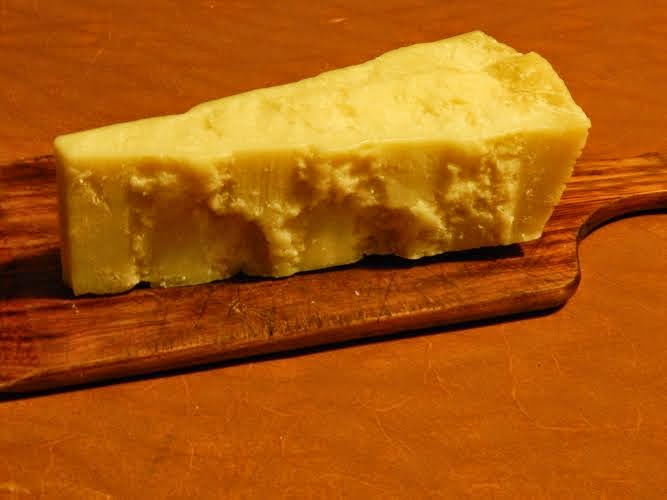
The texture of Grana is softer and less granulous that the Parmigiano, and makes it ideal as an appetizer or antipasto. If you want it as an aperitivo, eat it with bubbles! We would suggest you to drink a Prosecco sparkling wine with the Grana Padano. Another way of eating it is the so called "raspadura", very typical of Lodi, but also in Pavia or Cremona. Just scrape off the upper part of your Grana with a particular knife, and you'll obtain a thin layer of Grana Padano, so delicate and tasty. This would be impossible to obtain with a Parmigiano Reggiano.

It is impressive to think that you need 15 liters of milk to obtain just a kilogram of Grana Padano cheese, and every wheel of Grana weights from 24 to 40 kgs!
The Grana Padano must be left ripening from 9 to 20 months.
Well, that's it! Next step is to go out finding your wheel of Grana Padano DOP (always choose the original, do not trust Parmesan or so, they're just low quality tacky imitations!)
Eat it as you want, grated on your spaghetti (we always suggest the pasta from Gragnano), in little cubes or in the traditional raspadura way!

The raspadura from Grana Padano


Enjoy your life, enjoy it with cheeses!

Tom

miércoles, 9 de abril de 2014

The Gorgonzola cheese

When you talk about Gorgonzola, you immediately think about one of the most important cheeses in every italian kitchen. It is frequently confused with other kinds of blue cheeses, like the english Blue Stilton or the french Roquefort. But behind this delicious cheese there is a whole lot of history with capitular h, and also many legends and myths. One would think it would be an alchemical product, rather than a cheese, whose secret has been told generation after generation until recent times, when it finally seems to start getting the international fame it surely deserves. But the way until the complete rediscovery of Gorgonzola has a very long way to go, since you can still find in shops around the World just the soft and sweetend version of it. Trust us, to eat the real thing, the spicy tough Gorgonzola cheese, when authentic and produced like 1000s years ago, is a true legendary culinary experience you won't never forget!

When we start hearing about Gorgonzola cheese first? This is one of the oldest cheese still in commerce now ever, so we gotta go back and back and back. And back again! The first document talking about a cheese having all the main feature of Gorgonzola is from year 881 a.C., when the Archbishop of Milan, Anspertus from Biassono, in his last will described this kind of cheese. But legends put the turning point in the history of Gorgonzola even earlier. According a legend, in the year 879 a.C., the blue cheese would have been invented in the Gorgonzola borough of Milan, explaining the name of this cheese. Another legend wants that the cheese would have been invented in the VIII century a.C., when some sheperds, coming back from the Alps with their sheeps, would have stopped overnight and there, without the instruments to make their typical Lombard creamy cheeses like Crescenza or Quartirolo (we'll talk about these ancient cheeses too, do not worry) would have mixed the curdle of the previous night with the fresh one of the morning. That "error" would have eventually lead to the creation of the Gorgonzola cheese.

The Gorgonzola cheese is know also as the "Grandpa's cheese"

The "Zola" cheese, as is informally known here in Northern Italy, had huge success from the XIX century, when it was discovered in the kitchens of the European high aristocracies by merit of its taste, just so original and unmarchable (if you tried the original Gorgonzola, you'll know what I mean).
It is just so different from other blue cheese, like what Guinness is to other beers.
In the other blue cheeses, the milky part prevail over the aromatic part, instead with the Gorgonzola the strong spicy and  aromatic part dominates the milky part, but without being too much in your face. It is an incredibly culinary controlled risk the Gorgonzola, but when you'll eat it, you'll just go "whoa!" like you've just had a rollercoaster experience. 
There are lots of curiosities too, for example the Gorgonzola was the only italian cheese present in the first class dinner in the menù of the Titanic. Not even the Pecorino nero di Pienza or the 36-months-old Parmigiano Reggiano was there!
Some decades later, we can add that Churchill himself, in the heavy Milan bombings by Royal Air Force, forbid the planes to hit the city of Gorgonzola, so to not damage the production of the cheese he was very fond of.
What makes its taste so different and unique? It is because of the higher number of different types of bacterical cultivations inside the cheese. Other blue cheese have only the pennicillium roqueforti, that gives light blue veins, but the green veins of the Gorgonzola comes from another kind of bactery, the pennicillium glaucum, enriching the flavour.

The gourmet food lovers just adore the original Gorgonzola Piccante!

Even if today you can find in many supermarkets worldwide the sweet version of the Gorgonzola cheese, there is a different version, realized exactly as it was produced 1200 years ago: the Gorgonzola Piccante, or the spicy Gorgonzola. The differences are overall in the consistence of the cheese, the sweet one being creamy and somewhat melted, with fewer blueish veins with a delicate colour. The Gorgonzola Piccante is tough in consistence and taste, and the veins are much more evident. The Zola Dolce needs a ripening of two months maximum, while the Piccante needs a ripening of three months at least. Because of the very traditional way of making it, the Gorgonzola Piccante is very complicate to find it outside of Italy, so if you get the chance to see it, don't hesitate and buy it! You'll be rewarded with a strong and involving taste, ideal to drink with strong red wines like the Piedmont's Barolo (isn't it the king of wines? Drink it with the king of cheeses then!), the Brunello di Montalcino, the Amarone or the Barbaresco.
Try it with some rustic crunchy bread, and you'll understand the full range of the Gorgonzola cheese taste. Both the Gorgonzolas, the Dolce and the Piccante, are a real secret weapon in the kitchen, you can use it to do white sauces (for example our gorgonzola bechamel sauce), or as an ingredient in your pizzas, or even with meat or gourmet hamburgers. In the risottos the Gorgonzola is the ideal match, maybe with some red radicchio salad.

What are you waiting for? Go and find this gorgeous blue cheese, but be careful of the countless imitations, only the original has the "g" for Gorgonzola!


Only the real one has the "g" symbol for Gorgonzola!
Greetings!

Tom