Mostrando entradas con la etiqueta sweet. Mostrar todas las entradas

sábado, 4 de abril de 2015

The italian Easter Colomba cake


When you think about Easter time in Italy, the first things that comes up to your mind are sweet desserts, there are just too many Easter-themed sweet dish that you wouldn't believe! North to south, there are chocolate eggs, casatielli, pastiera, cassata...you name it! But there is a dessert that makes everyone happy: the Colomba pasquale, a cake very similar to the fluffy Christmas panettone shaped like a dove. "Colomba" in italian means actually "dove".


While the symbolical meaning of a dove-shaped cake to celebrate Easter is clear to everybody (dove is the symbol of Peace), the historical origin of the Colomba pasquale is somehow unclear.

Pavia still has lots of heritage from the Longobards era.
Of course, like everything else in Italy, there are lots of legends around it. One of them settles the birth of the Colomba in the era of the fall of the Western Roman Empire. Italy's falling under the hammer of the barbarian invasion, we're in year 572, and Alboin, the king of the Longobards, is taking in siege the roman city of Ticinum (nowadays Pavia). After the conquer of Ticinum, the king is decided to execute a large amount of the population. To avoid the unpleasant decision, the ticinenses decided to create a delicious culinary gift as an hommage to the king Alboin: a sweet bread shaped like a dove, in sign of pacification. The cake is so tasty that the king decide not to execute the population: a good dessert can actually save thousands of lives! And there's more to it! Ticinum later became the capital city of the Longobard reign, under the name of "Papia", that is the city of the "pope" (or to better say, the main religious authority of the Longobard reign, the Arian Archbishop).

Loved the legend? Want one more? Ok here it goes: we're again in Lombardy, some decade later that the history of Alboin we saw before: the Longobard reign is now completely settled, and the legend we`ll see takes place when the king is Agilulf and the queen is the catholic Teodolinda.

Queen Teodolinda portrayed in a fresco in the Teodolinda Chapel, in the cathedral of Monza. A masterpiece of gothic art from the Zavattari brothers, a must see!
The carismatic queen Teodolinda wanted to convert many of her subjects from Arian heresy to catholic orthodoxy, and to do so she invited lots of great preachers of the time in Lombardy. One of these great preacher, that was reaching Rome through the Via Francigena (a great pilgrimage route like the Camino de Santiago), was Saint Columbanus, an irish monk.

The Via Francigena pilgrimage route passing through Pavia


When invited to a lunch with the queen Teodolinda, just few day prior to Easter, he found himself very uncomfotable: too many dishes, too many meals and kinds of meats and he was in the amidst of Lent Fasting. To find a solution, he offered himself to bless the food. But no sooner had he blessed the lunch than the meat was transformed into a delicious sweet bread shaped -guess how?- like a dove! Wow! A miracle! Saint Columbanus, which is a latin translitteration of the irish words Colum Bann, "white dove", actually transformed the meals according to his name. He was a boss!

The original Colomba pasquale by Motta

That's enogh with the legends, but what about the real history of the Colomba? Well, the history is actually more prosaic, and it startes in the Thirties of the Nineteenth century. The creator of the modern days Colomba is the ad man Dino Villani, that wirked for the Motta, an historical firm that produces (back then as it does now) the milanese Christmas cake par excellence: the Panettone. Dino Villani had the brilliant idea to keep working the industries after the Christmas season producing the traditional dove-shaped cake using a modified version of the dough of the Panettone. Of course, the idea was a big time success! Dino Villani was a genious and one of the very first modern-days advertising man: he also designed the Motta "M" logo that you can easily identificate all over the world with high-quality milanese sweet threats.

The iconic "M" sign for Motta, idea of the advertising genius Dino Villani

Now that you have the complete story, you can choose which one you prefer to believe in! The Colomba is a delicious dessert, you can find it at any good Italian shop or also at Eataly (and there you can find the Motta's Colomba too!).
Today, the Colomba is an excellence traditional italian product enlisted as a P.A.T. (Prodotto Agroalimentare Tradizionale) by the italian Ministry of Agriculture.
Don't miss it if you can!

Buona Pasqua!
Image and video hosting by TinyPic

martes, 10 de marzo de 2015

The Engadin nut tart


Today we'll talk about a dessert that will bring you suddenly in the heart of Europe, surrounded by Swiss Alps. We're talking about the Engadin nut tart, called also Graubunden nusstarte in German language or torta engadina in Italian.

The Engadin nut tart is a typical swiss pie from the Engadin region, in the canton of Grisons. Engadin in the romansh language (the original language of the canton) means literally "Garden of the Inn", because of the river Inn, that cross the valley. 


Maybe you have heard of St. Moritz, one of Europe's most famous ski destination, that is the capital of the Engadin valley. This most beautiful alpine region has also the "Trenino Rosso", or the Bernina Express, a pretty little panoramical train that offers breathtaking view of the Alps...literally from above the mountains. This train has also gained the Unesco World Heritage site title, one of the very few railway track to obtain this result! We must confess to you that we discovered the Engadin nut tart during a trip on the Bernina Express! Since then, every time we go to Switzerland or hop onto the Bernina Express, we return back home with a lot of Engadin nut tarts in our backpack!


The Bernina Express, image found on Pinterest


The awe-inspiring beauty of the Engadin atracted lots of artist, for instance one of the biggest name is Giovanni Segantini, one of the most important painter of the XIX centuty (yet largely unknown to the large public). In his lifetime, he never had passport, he did never undestand what borders were, he just followed the beauty of nature. That lead him to Engadin, in Switzerland, where he find a second home in Maloggia. He was one of the bigger divisionist and symbolist european painter, he always looked for God in the beauty of nature, he was a sort of a druid trying to grab a pantheistic deity with his art. He died of pneumonia trying to paint an alpine scene en plen air above the Schafberg mountain. If you're interested in his work, one of the painter most know works is the "Trittico delle Alpi", the tryptic of the Alps, that you can see in the Segantini Museum of St. Moritz, with the largest collection of this painter.

Leaving the brushes on a side, the Engadin nut tart, or the "tuorta de noush engiadinaisa", as it is called in romansh language, is a delicios pie made of walnuts, almonds and caramel. It is an ancient recipe, based upon a tart made with a lot of butter called "fuatscha grassa".


Between the XV and the XIX century many pastry chef from Engadin migrated in other europeans country, spreading their culinary art throughout the Old Continent. Many Engadinese pastry chef emigrated from instance to Venice in Italy or Toulouse in France. In one of these migrations, the "fuatscha grassa" meet the walnuts, and it was love at first sight! The cold weather of Engadin, infact, is not fit for walnuts to grow, so the typical Engadinese nut tart is actually made with...foreigner walnuts! This sort of mix of different product coming from different alpine sides and alpine nations is a very frequent exchange that enrich the variety of the Alpine Euroregion.

It is a dessert perfect for any occasion, since it last long after its preparation. The very first Engadin nut tart as we intend today was commercialized in 1926 by Fausto Pult in Samedan, very close to the Bernina range that named the little red train of the Bernina Express railway. In 1934, Fausto Pult presented his Engadin nut tart at the Basel fair. It immediately became a success, and nowadays it is very beloved by the ski tourists visiting St. Moritz.


Ingredients: (For a 22-24 cm wide tart)

For the pie crust:

- 275 g. of flour
- 175 g. of butter (cold)
- 75 g. of sugar
- 1 egg
- a pinch of salt (1/4 tsp)

For the filling: 

-150 g. of sugar
- 4 spoonful of water
- 130 g. of walnuts
- 25 g. of sliced almonds
- 200 ml. of heavy cream
- 1 spoonful of honey


Preparation: 

1- Let's start preparing the pie crust. It can't be easier! You just have got to pull all the ingredients in a bowl and mix them all together. Please use cold butter in this phase, cut it into dices so it will melt well into the dough. If you see that the dough is somewhat sandy and not so homogeneous, just add a couple of spoonful of water to the dough, and you'll see it turn into a perfect pie crust! Knead it into a ball, cover it with plastic wrap and pop it into the fridge while you'll prepare the filling.

2- Let's deal with the filling: pour the water and the sugar into a pot on low heat until it starts boiling. Then lower the heat and we wait until it becomes golden brown, then the remove the pot from the heat. 

3- We put our minced walnuts into the pot, the sliced almonds and some heavy cream, then we put the pot back on heat. In just a matter of minutes we'll have a liquid cream. At this point we'll add the honey, we'll stir for a while and then we remove the pot from heat and we let the mix to cool completely.

4- Let's prepare the mould of our pie. Grease the mould, preferably a metallic one. Lay the pie crust above the mould with the help of a rolling pin, use half of the dough, the rest will be used to cover the filling of our pie. The pie crust will be some 2 cms thick, and the edges must be covered too. After that our filling has completely cooled down, we'll pour it into our pie crust, the surface of the batter must be nice and even and then we cover it with the remaining pie crust. To close the edges, we'll use a fork and we seal the filling, creating the trademark edge of the Engadin nut tart. At last, we'll pinch the surface of our pie so that it won't blow up during the baking.

5- We pop the mould into a preheated oven at 180ºC for some 55 minutes approximately. Let it cool onto a rack and...time to eat, my friend! 


This pie last long, you can keep it into the fridge covered with plastic wrap for up to two weeks.


Buon appetito!
Image and video hosting by TinyPic

miércoles, 11 de febrero de 2015

Ovis Mollis: your next favourite sweet treat!


Ovis Mollis! Even if this may sound like a magical formula drawn directly from Harry Potter's high classes at Hogwarts, it's not an hocus pocus at all...even if only magic would explain the sudden disappearance of these cookies in a matter of second! Today we bring you the recipe of a delicious italian cookies that are made with pasta frolla, an ancient italian super crumbly version of what had later been know in English speaking World as pate brisee. Let's try this version, let's try pasta frolla! It's outrageously simple and I still haven't met anyone who hasn't deeply enjoyed these cookies!

The Ovis Mollis are a typical kind of cookies traditional of the North Western part of Italy. In the dough of this particular version of the Pasta Frolla the key ingredients are the boiled egg yolks instead of fresh yolks, which makes the texture of these cookies simply irresistible, they seems high patisserie, and they even taste better than high patisserie if we may be completely sincere with you. But they are super simple to do!


Their name, Ovis Mollis, mention the latin word "ovis" that in this case may be translated into "egg", indicating us the key ingredient of the recipe, but ovis may also mean "sheep", and in this case the phrase would be translated into somewhat similar to "fluffy as sheep wool", maybe because of their very typical "cloud-like" texture.


The Pasta Frolla is the base ingredient for many italian sweet dishes, that is much more crumbly, inestable and sandy than the pate brisee. That may be considered somewhat an handicap when preparing pies, but it's actually in the taste that the Pasta Frolla just brings us into another level. In italian, frolla means somewhat inestable, and the name tells us all about it! It is used into a lot of pies like the crostata, like the torte (tarts), like the frolle (sandy cookies) and the pasticcini (petit patisserie).

It's difficult to discover the history of Pasta Frolla, because it's an ingredient so universal that everyone claims the paternity of the recipe. So, let's stick to the facts: the first mention of this dough is to be found around year 1000 in the Republic of Venice, the Gate of the East.

Of course, we know that through the Serenissima (as it is called Venice), many products were introduced to Western Europe, like the sugar cane, imported from Egypt and Siria, quintessential ingredients for the pasta frolla. Lately, around year 1600, the pasta frolla reached the modern texture and taste, almost in the same time when the pate brisee was first described in the recipe books in France.

The Ovis Mollis, as we previously mentioned, are made with a kind of Pasta Frolla where the egg yolks are boiled and not fresh and it is used potato starch too. Maybe their origin is to be find into a cookies from Piedmont, called the Margheritine di Stresa. We are in the year 1857, in the very beautiful town of Stresa, in the Lago Maggiore, one of the most beautiful northern Italian lakes facing the Alps. When still a little girl, the future queen Margherita di Savoia (the queen after whom the Pizza is named, that queen may have been the World's first foodie!) used to enjoy its vacation in the Villa Ducale of Stresa, where a pastry chef, Pietro Antonio Bolongaro, was seeking an unique recipe for a cookie that were as fluffy as a cloud.

These cookies were offered to the future queen at her Forst Comunion, and Margherita suddenly fell in love with them. These cookies, named then "margheritine di Stresa" after her, were used also in the official meetings with the Queen after she moved to Rome at the Qurinal Palace. When the the son of the pastry chef Bolongaro inherited the atelier of his dad, he decided to sell these cookies to all, because they were just too good to be only a King's delicatessen. Still now, after 150 years, the "margheritine di Stresa" are a most typical product of the Lake Maggiore area.

The lake Maggiore and the Alps as seen from Isolabella


Ovis Mollis seems to be strongly related to the Margheritine di Stresa, since the two recipes have almost the same ingredients, even if the Margherite have less boiled eggs in their recipe.
Unluckily, we have no detailed histoty for the birth of the Ovis Mollis, but we can tell you that they appears for the first time in the 1907 book by Giuseppe Coccia "Il pasticcere ed il confettiere moderno" (the modern pastry chef and confectioner). Ciocca was a very creative artist/chef that was born in 1867 in Treviglio, an enchanting town between Milan and Bergamo. Truth be said, the recipe that we can find in Coccia's book is different from what we can we can see in modern days pastry shop: they are somewhat similar to little, flat doughnut.

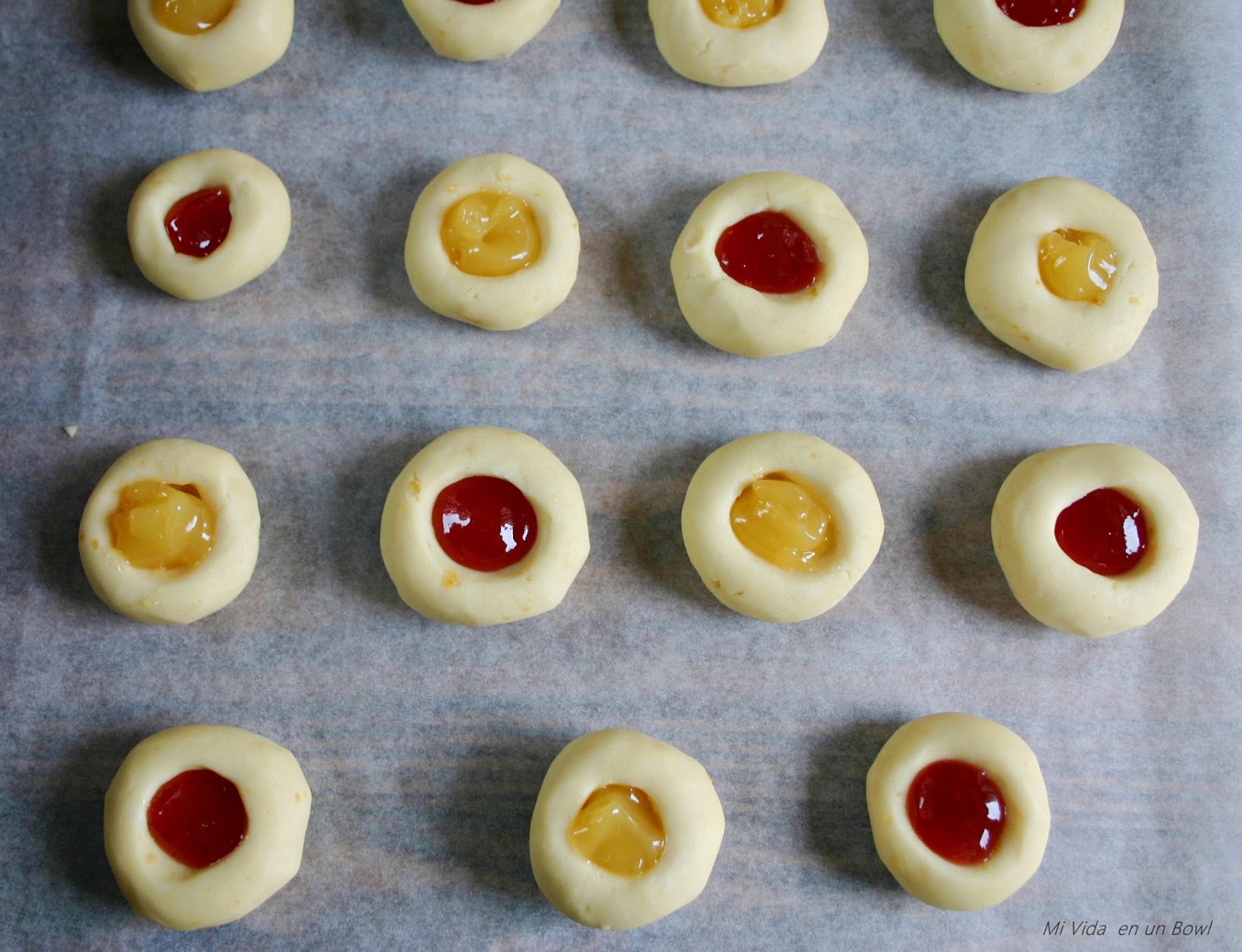
The version of the Ovis Mollis that we show you today is maybe the most frequently used for this kind of Pasta Frolla, and it is called in the pastry ateliers as "Occhio di Bue", or in english "eye of the ox": balls of dough lighty pressed at the center, creating a sort of hollow filled with cream, chocolate or jam.


Recipe: 

Ingredients:


200 g. of unsalty butter

200 g. of flour
100 g. of icing sugar
100 g. of potato starch
5 boiled egg yolks
1 spoon of Vanilla extract (or some vainillina)
a pinch of salt
Some jam for the filling

Preparation:

1- Start with boiling the eggs and separating the egg yolks and the eggs white. Shred the egg yolks and then put them aside.


2- We put all the ingredients in a bowl: the flour, the shredded egg yolks, the potato starch, the cold butter sliced into dices, sugar and a pinch of salt. Knead it until we obtain an homogeneus dough. Cover the bowl with plastic wrap and pop it into the fridge for about two hours.


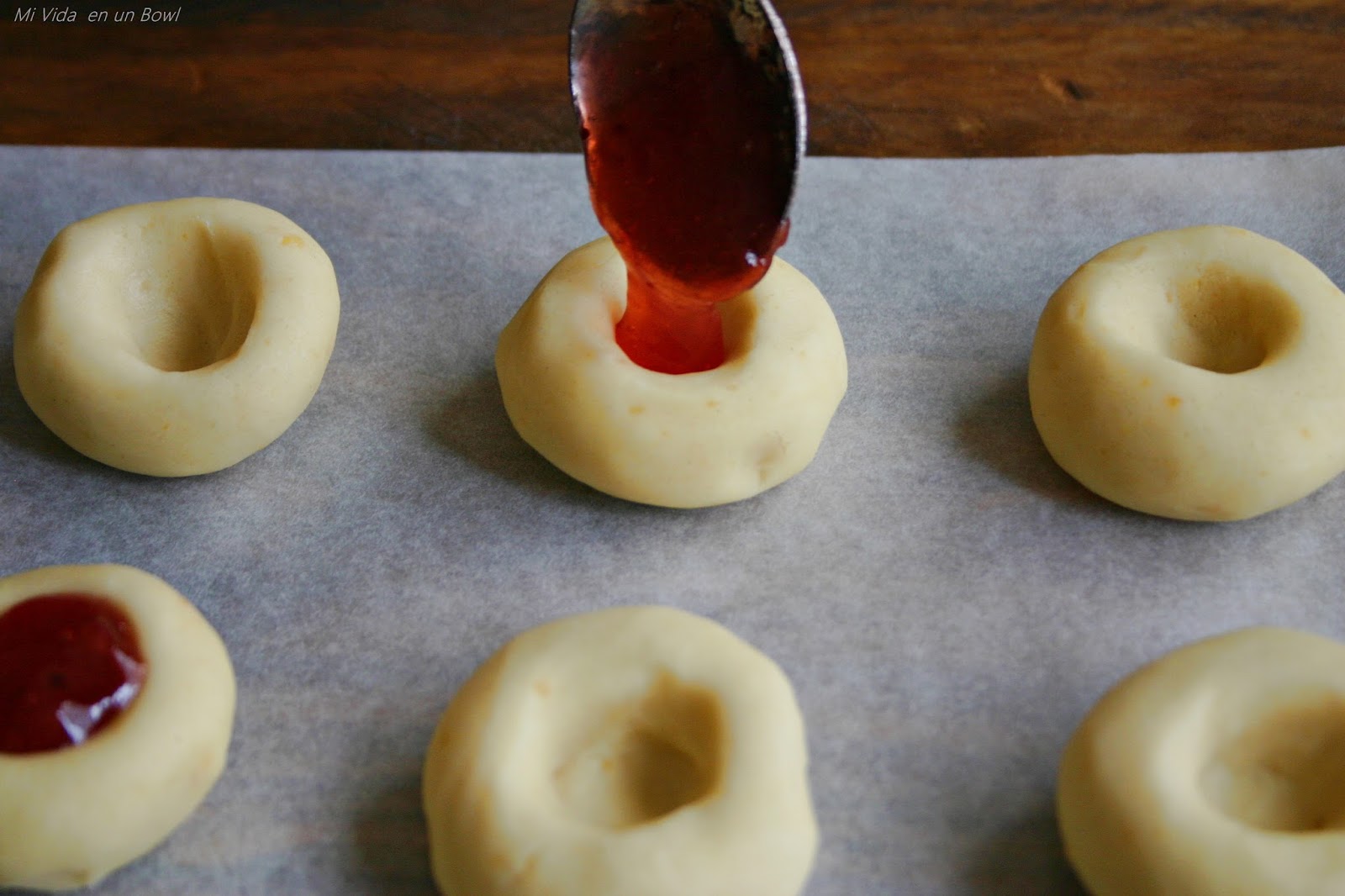
3- After two hours into the fridge, we cut the dough and we make little balls some 3 centimeters wide. We put it into a tray covered with baking paper, then we lightly press the center of the little balls creating the hollow for the filling.


4- Preheat the oven at 180ºC. These cookies can be baked with or without the filling, if you prefer. We usually choose different kind of jams and fill the cookies before we bake them, in this case we've chosen red fruit jam and lemon curd...yummy!


5- Bake the cookies for 12 to 15 minutes. Do not let the cookies to overbake, we don't want them to become golden brown, they must remain somewhat pale, otherwise they would be too much friable.


Enjoy them! Remember the magic formula for these italian cookies: Ovis Mollis! They'll put a spell on you!
Image and video hosting by TinyPic

jueves, 6 de noviembre de 2014

Candied fruit filled Donut


rosquetes rellenos de fruta o pasas


Want something sweet, fast and easy for these autumn's afternoons? Well, that great! Put a pot of water on heat, we'll bring you some rosquetes!

Rosquetes, rosquillas, donut...they have a thousand of names! But they all have got an important characteristic: they're all sooo good! They're typical in many festive occasions, like Christmas, Holy week or Carnival, but they're excellent for any occasion throughout the year, as a breakfast or a snack too!

Today we'll bring you a double donut, they're extremely easy do to, I grant you, they will be eaten in a blink of an eye! They're filled with raisin and almond, but at the endo of the day, you choose freely the ingredients, you can change it your way! So, what are you waiting for? Join the donut cause! Furthermore, if you've got children, they'll have a load of fun! Oh, just don't consider the mess you'll have in you kitchen...flour! Flour everywhere! Well, at least they've enjoyed the baking!


Ingredientes básicos para hacer rosquetes
Ingredients 


Ingredients:

  • 400 g. of flour
  • 100 g. of sugar
  • 2 eggs
  • 100 ml.of olive oil
  • 100 ml. of milk
  • 1 tsp of aniseed
  • 1 tsp of  baking powder
  • 100 g. of minced almonds
  • Candied fruit or raisin to taste
  • Oil to fry


rosquetes de pasas
Rosquetes, rosquillas...no importa cómo los llames, están buenísimos!


Preparation:

- Mix together all the ingredients, adding last the sifted flour.

- Knead a little bit with the hands in a table or a surface covered with flour, until you obtain an uniform dough. It shouldn't be too sticky, you want it just to be a little bit soft. Cover it and let it rest a while.

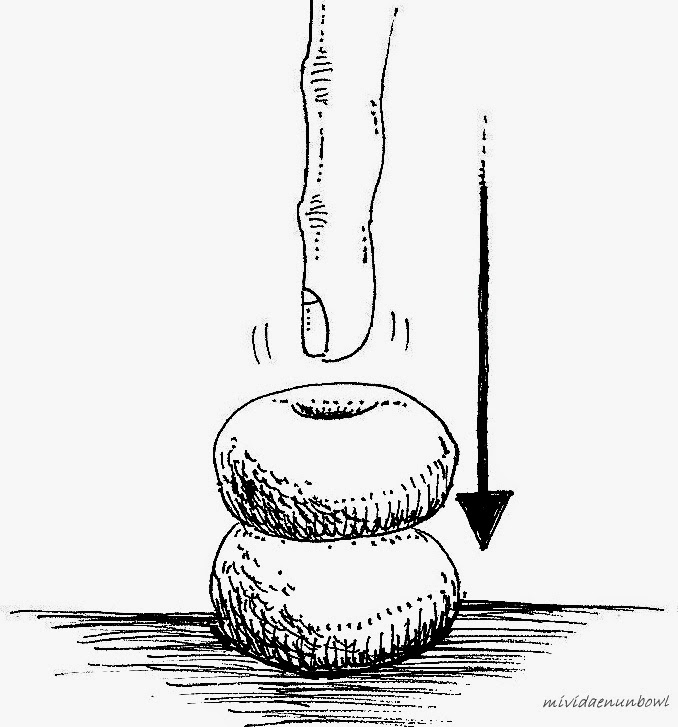
- Grease your hands with the oil so the dough will not stick to you hands and work the dough until you obtain balls that are more or less uniform. Put a ball above the other and insert your finger in the dough so to punch a hole in the dough and stick together the two donuts. In this way you'll have a "twin donut".


- Fry them in abundant hot oil. Use a deep pan to fry them, so, when you put the donuts to fry one by one, they'll drown at the beginning, but then they'll float. When they do so, just turn them upside down and when they'll be golden brown, just take them out of the boiling oil and sprinkle them with confectioner's sugar. They're just so fast to do!


Interior del rosquete
Yummy! The interiors of these donuts looks like a cake!

Image and video hosting by TinyPic

miércoles, 17 de septiembre de 2014

The Gelato Affogato al Caffè

The Gelato is an all time favourite dessert, and it's now enjoyed all year round. The old days are gone, when you had to wait until summer to have an ice cream! For this reason, we want to tell you about a super simple and easy recipe, ready in three fast steps!


It is the kind of self-indulgent excuse that  italians have developed to keep eating gelato even in the cold winter, even at Christmas! It is called "Affogato", and even if the word in italian may sounds nice and sweet, it actually means "drowned". The recipe explains it all: it is made actually drowning the gelato into a lot of coffee. Coffe and Gelato. Come on, isn't it great? Throungh this match of flavours, your ice cream will gradually melts, becoming partly cold and partly frozen, making your mouth go flippin' crazy! 

This is a very simple, almost basical, obvious invention, we know. But, as all the simplest thing in the world, it's simply genial. The taste is very refined, elegant and aromatic, if possible the coffee enrich the taste of the gelato even more! Do you remember how the contrast bitter-sweet works? Well, the bitterness of the coffee boasts the sweetness of the ice cream! We do not have any information about who may have invented it and when/where, what we know is that this kind of delicious hybrid is gaining momentum every single day. Probably, as the best culinary invention, it will become a classic throughout Western World in a matter of a few years.


The Affogato has even triumphed at the Gelato World Cup!

For instance, it's striking that in the event that took place in Rimini, Nothern Italy, from 5th to 7th of September 2014, the "World Gelato Tour" at the Sigep fair (international fair of gelateria, pastry and baking) and organized with the Università del Gelato Carpigiani, the world's best gelato prize was given to...an affogato! The full name is "Mandorla Affogato", or almond affogato, created by the Aussie bros John and Sam Crowl. More details on the ingredients? Sirs and madames, hold on to your hats! Vanilla from Madagascar, Variegato with caramelized and toasted almonds, Kenya coffee, with salted caramel sauce.
We'll breing you here a stripped down and more simple and accessible version of this delicious dessert, but we're sure you'll enjoy it almost as we do, and we do enjoy it a lot!
In three simple steps:


Ingredients:

- Ice cream (smooth tastes, like vanilla, stracciatella or so)
- coffee (good coffee, not too watery. The ideal would be an espresso or moka coffee)
- Bayleis cream whiskey or similar
- In alternative, you can use hot chocolate or masala chai tea instead of coffee.

Preparation:


- Prepare a good coffee, a discrete amount of it. You can use your Moka coffee pot, the taste of the coffee is quintessential, it must be not just good, but "buono buono!", otherwise the Affogato will result too watery. Here for instance we tell you about doing a great coffee at home with the Moka! Most important is never put sugar in your coffee, you want it to be bitter as hell!

- Take a gelato, possibly a vanilla, almond, fiordilatte or stracciatella one. Remember to avoid strong ice cream tastes: it is an italian recipe, and we know how italian dishes permit just one "primadonna", that is only one main taste. And in the Affogato, the main taste is the coffee. If you don't dig the coffee, you can surely use hot chocolate instead, or even tea, we like it with chai tea.


- Take a cup of a glass, and put the ice cream in it (remeber that the gelato goes first, otherwise the ice cream will sadly float above the coffee), then add some whiskey cream like Bayleis and then add the coffee still hot and...the magic! Yuo'll see how the ice cream and the coffee will melts in a match made in food heaven! A warm cream, a cold gelato and a hot coffee...what more can you ask for?


We hope you liked the recipe, have a nice week!

ToM

miércoles, 25 de junio de 2014

Pumpkin sweet in 3 simple steps


The pumpkin cake or sweet we're talking about today is one of those recipes perfect for any time of the year, since it has to be eaten cold and without a spoon. It's perfect for celebrations, snacks or even party where guests help theirselves, everyone with a piece of this cake and happy with that!

Furthermore, it's so easy that you've no excuses! You can prepare it in a few moments and for the rest you've got your dear friend: mr. Oven! ;)

Ingredients:

  • 1 Kg. of pumpkin
  • 4 eggs
  • 300 g. of flour
  • 200 g. of sugar
  • 250 ml. of milk
  • 125 ml. of olive oil
  • 1 drizzle of liquor (optional)
  • 1 Tsp of Royal
  • 1 Tsp of Vanilla extract
  • 1 tin can of condensed milk ( 370 g. aproximately) 
  • lemon zest


Preparation:

1- We cut, peel and cook well the pumpkin, then we let it dry well, and we shred it with a food processor.


2- We add all the remaining ingredients to the shredded pumpkin, and stir it well until we obtain an homogeneous mix. Remember to sift the flour befor adding it to the mix, in order to avoid bulks.

3-Grease with butter or with olive oil your mould (in my case, a rectangular mould of 30x18 cms), pour the mix in it and we cook it in a preheated oven at 120°C for some 75 minutes or so.

Our cake in the oven

And there you have it! Ready! Let it cool down, take it off from the mould and cut it into pieces. Once it's completely cold you can put it into the fridge to preserve it longer.


It's a very smooth and creamy sweet. If you're like me and you don't dig pumpkins, you'll surely like it anyway, as I do! Try it and it will surprise you!


Greetings!

AnGie


sábado, 21 de junio de 2014

Welcome summer! Tiramisù popsicle recipe

To celebrate the coming of summer, we'll bring you a popsicle based on a very classical italian sweet: the World renown Tiramisù.


The Tiramisù is a very simple sweet dish, but it's not a classic in the sense of "old", it's a rather "new classic", since it was invented in...1962! I mean, come on! That's the day before yesterday! ;) How could people live without this marvel?

The original recipe was an idea of Mrs. Alba Campeol, in the beautiful city of Treviso, very near to Venice. She affirms that the idea came out after giving birth to her first son, when her mother and her mother-in-law used to bring her coffee and ladyfingers and tell her: "eat them all, that'll be good for you!". In Italian we say "tirare su" (rise up, come on!) when someone needs to get better, and starting with this idea, she decided together with the cook of the restaurant they owned to add some nourishing eggs with sugar and the mascarpone cheese.

Even though many (or everybody) thinks that Tiramisù has some liquor in it, it actually hasn't. Or shouldn't have, according Mrs. Campeol's original recipe, since it was precisely designed to be fit for everyone, from the childhood to the oldest one, and specially for those who needed to "tirarsi su", to recover themselves, making the liquor unfit for the recipe. The many tourist that visited the enchanting city of Treviso (we would advice you to do so!) were blown away from the simple and genial recipe, making it Worldwide famous, and this lead to the many versions of this sweet that we have nowadays.

Here you are an interview to Mrs. Campeol (in Italian) where she tells us the history and she also regrets not having patented her recipe in the Sixties! We're thankful and grateful anyway, Mrs. Campeol!


Ingredients:
  • 4 egg yolks
  • 2 egg whites
  • 100 g. of sugar
  • 400 g. of mascarpone cheese
  • 3 or 4 Savoiardi biscuits or ladyfingers
  • cocoa powder
  • a cup of coffee
  • a pinch of salt

Preparation:


1- Beat the egg yolks until they get foamy with an electric blender. You're looking for a pale white colour.

2- Add to the previous mix the mascarpone cheese and mix it togheter.
 
3- Beat the eggs white until they become foamy and we add this to the previous mix with round movements, from bottom to top in order to let the foam stand up straight.

4- We dip the Savoiardi or the ladyfingers in the coffee (it can be decaffeinated, instant coffee or espresso, you choose).


5- We put our mix in our popsicle or ice cream moulds, alternating with coffee-wet ladyfingers and cocoa powder and our mix again, as many times as we want, until the mould is filled and we end with some cocoa powder, then we put our wooden stick. We can also decide to put the ladyfingers at the center of the mould and the mix around them. This time I decided to do it with some little pieces of ladyfingers, that's a matter of tastes!


6- Put it into the freezer, if it's possible from a day to another, since it's a very creamy mix and it needs a lot of cold.


This time I've made it as a popsicle, but you can do it in a plum cake mould too.
Before pouring the mix, I cover the bottom with a plastic wrap, in order to avoid that our Tiramisù does not sticks to the bottom and can be removed easily. This version is to be made just like the popsicles, but with some more savoiardi biscuits and forming and alternate structure, just like the traditional Tiramisù: biscuits, mascarpone mix, cocoa powder and others biscuits, in that orden. This is what is called a "semifreddo", a sweet between a gelato and a traditional cake.


Happy start of Summer to everyone! Enjoy this ice creamy version of the Tiramisù!

Greetings,

AnGie